SOUTH FLORIDA FAMILY LAW
South Florida Paternity Lawyer
Protecting Your Parental Rights, Your Child’s Future and What Matters Most
Questions about paternity can affect parental rights, time-sharing, child support and important decisions about a child’s future. Caroline Olson, P.A. provides clear, practical guidance with competence and compassion.
Protecting What Is Most Precious To You Since 1999
DNA paternity testing report and sample tube representing legal paternity matters in South Florida.
Guidance You Can Feel Comfortable With
Family law issues are personal. Caroline Olson takes the time to listen, explain your options in understandable terms and develop an approach based on the needs of you and your family.
- Effective, Solution-Oriented Approach
- Competence and Compassion
- Free Initial Consultation
- Three Convenient Office Locations
Establishing Paternity Can Create Clarity for the Entire Family
Legal paternity can define important rights, responsibilities and protections for both parents and children.
Establishing paternity formally identifies a child’s legal father. For a child, that can affect access to family medical history, financial support, insurance benefits when available, inheritance rights and other protections. For parents, paternity can also provide the legal foundation for child support, parenting plans, time-sharing and parental responsibility.
How Can Paternity Be Established in Florida?
The appropriate process depends on the parents’ circumstances and whether parentage is agreed upon or disputed.
Parents Married When the Child Is Born
When the mother is married at the time of birth, her husband is generally recognized as the child’s legal father.
Voluntary Acknowledgment
Unmarried parents may establish paternity voluntarily through the appropriate acknowledgment process.
Administrative Determination
In qualifying cases, paternity may be established administratively, including through genetic testing.
Paternity Through the Court
When paternity is disputed or judicial intervention is needed, a paternity action can be filed in court.
When Paternity Becomes a Legal Issue
Getting legal advice early can help you understand the consequences of the decisions you make.
Every family is different. Paternity cases can become particularly important when a parent wants legal recognition, another party disputes biological parentage, child support is being requested or questions arise about parental responsibility and time-sharing.
Seeking legal recognition as a father
Responding to a paternity action
Questions about DNA testing
Child support connected to paternity
Time-sharing and parental responsibility
Disputing or disestablishing paternity.
What Role Does DNA Testing Play in a Paternity Case?
Scientific testing can provide important evidence when biological parentage is disputed.
Scientific testing can provide important evidence when biological parentage is disputed. A DNA result may answer the biological question, but the legal questions that follow can affect parental rights, child support, time-sharing and other responsibilities.
Establishing Paternity May Be Only the Beginning
Legal parentage can lead to additional decisions about how a child will be supported and how parental responsibilities will be handled.
Caroline can help you look at these issues together so that one decision does not create unnecessary problems elsewhere.
A Clear, Solution-Oriented Approach With Competence and Compassion
You should feel heard, informed and prepared for what comes next.
Paternity matters can involve uncertainty, strong emotions and decisions with long-term consequences. Caroline Olson approaches these cases by first understanding what matters most to you. She will help you identify the legal issues, understand the available options and develop a practical strategy designed around your circumstances. When an agreement can protect your interests, Caroline works toward an efficient resolution. When litigation becomes necessary, she prepares your case with the care and attention required to advocate effectively.
“Here to guide you with competence and compassion as you close one difficult chapter and look to a brighter and more peaceful future.”

Understand the Legal Consequences Before You Sign or File
A voluntary acknowledgment of paternity is more than paperwork. Likewise, once legal paternity has been established, changing that legal status can require court action. If you are uncertain about parentage, parental rights, financial responsibilities or the consequences of an acknowledgment, getting legal guidance before taking action can help you make a more informed decision.
Protecting What Is Most Precious To You Since 1999
Three Convenient Office Locations. One Consistent Standard of Personal Service.
Accessible family law guidance for clients throughout South Florida.
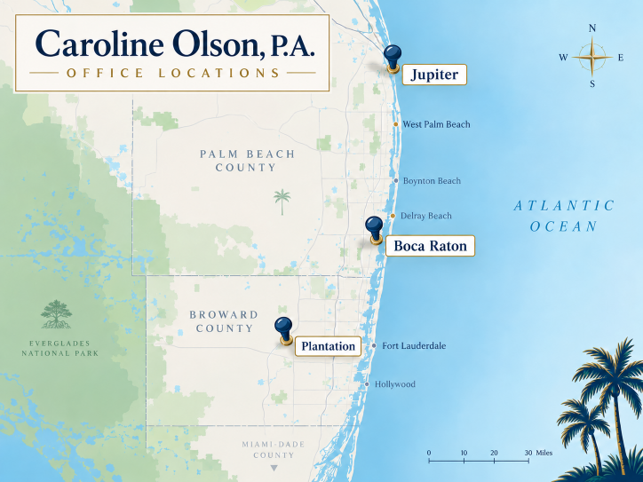
Caroline Olson, P.A. offers three convenient office locations in Jupiter, Boca Raton and Plantation and serves individuals and families throughout South Florida, including Boca Raton, Boynton Beach, Jupiter, Naples, North Palm Beach, Palm Beach Gardens, Plantation, Wellington, West Palm Beach and surrounding communities.
Boca Raton Office
- Boca Raton
- Boynton Beach and nearby
- South Palm Beach County communities
Jupiter Office
- Jupiter
- North Palm Beach
- Palm Beach Gardens
Plantation Office
- Plantation
- Nearby Broward communities
Frequently Asked Questions About Paternity in Florida
What does establishing paternity mean in Florida?
Establishing paternity legally identifies a child’s father. It can provide important rights and benefits for the child and both parents. It may also provide a legal basis for addressing child support, parental responsibility, parenting plans and time-sharing.
How can paternity be established in Florida?
Depending on the circumstances, paternity may be established because the parents are married when the child is born, through voluntary acknowledgment, through an administrative process, or through a court order.
Can unmarried parents voluntarily establish paternity?
Yes. Florida provides voluntary acknowledgment procedures for unmarried parents, including procedures that may be completed at the hospital or after the child’s birth.
Can paternity be established without going to court?
Yes, in some situations. Administrative procedures may be available in qualifying cases.
Can a judge order DNA testing?
Yes. Scientific testing can be ordered or used in a paternity proceeding when appropriate under Florida law.
Does establishing paternity automatically create a time-sharing schedule?
Not necessarily. Paternity can provide the legal foundation for addressing parenting plans, time-sharing, parental responsibility and support, but those issues may require separate determinations.
What if I signed an acknowledgment and later believe I am not the biological father?
Do not assume the issue will correct itself. Changing established legal paternity can require court action and should be discussed with an attorney promptly.
When should I speak with a paternity attorney?
Consider legal guidance when parentage is disputed, you are being asked to sign legal documents, you have received a paternity petition, you are seeking parental rights, child support is involved or you are unsure how paternity could affect you and your child.
Let’s Talk About Your Family and Your Next Step
You do not have to figure out a paternity issue on your own.
The decisions you make today can affect your parental rights, your responsibilities and your child’s future. Caroline Olson, P.A. will listen to your concerns, explain your options and help you determine a practical way forward. Start with a free initial consultation.

Contact Us
We will get back to you as soon as possible.
Please try again later.
Submitting this form does not create an attorney-client relationship. Please do not include confidential or time-sensitive information.